
Industrial Manufacturing Is Changing. Is Your ERP Ready? | LinkedIn
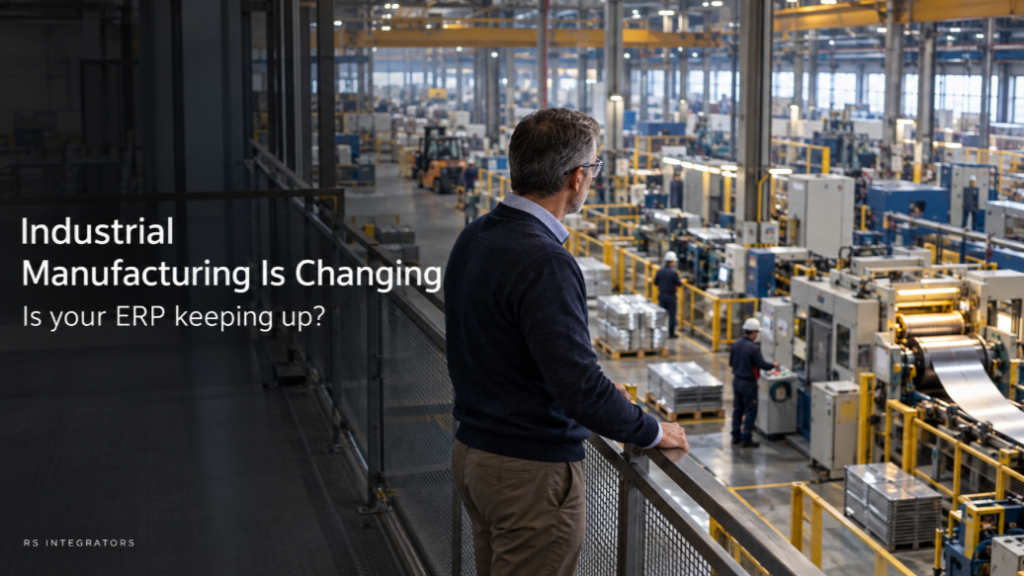
Industrial manufacturers are under pressure to accomplish several things at once: respond to supply-chain uncertainty, control production costs, improve delivery performance and introduce automation without disrupting daily operations.
But many manufacturers are trying to meet these demands while their business information remains divided across spreadsheets, legacy applications and disconnected processes.
Production may have one view of demand. Procurement may be responding to different priorities. Sales may promise delivery dates without complete visibility into material availability. Finance may understand the final cost only after the reporting period has ended.
The individual systems may still function—but the business is not operating as one connected organization.
Manufacturing complexity extends beyond the shop floor
Industrial manufacturing is not a single process. It is a connected chain of decisions involving:
- Sales and demand planning
- Material requirements
- Procurement and supplier management
- Production planning and execution
- Inventory and warehouse operations
- Quality management
- Logistics and customer delivery
- Product costing and financial reporting
A delay or inaccurate decision in one area can quickly affect every other area.
If purchasing does not have reliable demand information, critical materials may not be available when production needs them. If inventory records are inaccurate, planners may order unnecessary stock or promise quantities that cannot be delivered.
When production, sales, procurement and finance work with different information, employees spend more time reconciling data and less time improving business performance.
Four warning signs that the ERP foundation needs attention
1. Production planning depends heavily on spreadsheets
Spreadsheets can support analysis, but they become a risk when production schedules, capacity decisions and material requirements depend on manually maintained files.
Plans become outdated quickly, particularly when demand changes, a supplier is delayed or a machine becomes unavailable.
Manufacturers need a connected view of demand, inventory, capacity and material availability so planners can understand the impact of a change before it disrupts production.
2. Inventory is high, but materials are still unavailable
Excess inventory and material shortages can occur at the same time.
A company may hold too much slow-moving stock while still missing a component required for an important production order. This often indicates limited coordination between sales forecasts, procurement, inventory and production planning.
Better planning is not simply about purchasing more material. It requires clearer visibility into what is available, what is committed and what will be needed next.
3. Product costs are understood too late
Manufacturers need to understand how material prices, labour, overhead and production variances affect profitability.
When operational and financial information is disconnected, cost changes may become visible only after production is completed or the accounting period is closed.
Earlier cost visibility helps management evaluate margins, pricing decisions, sourcing alternatives and production performance while there is still time to act.
4. Every business change requires another workaround
A new product, plant, warehouse, supplier or customer requirement should not create another collection of spreadsheets and manual processes.
If expansion makes the organization increasingly difficult to manage, the problem may not be business growth itself. The underlying ERP foundation may no longer be able to support that growth efficiently.
Building-product manufacturers face the same connected challenge
Industrial manufacturing includes a wide range of businesses, including manufacturers of roofing products, flooring, tiles, windows, exteriors, wood products, plastics and other building materials.
These companies may need to coordinate raw-material availability, production capacity, demand by region, product variants, quality requirements, warehouse stock and transportation costs.
For example, a wood-products manufacturer must connect long-term material availability with current market demand, production planning and distribution. A flooring or roofing manufacturer may need stronger visibility across product configurations, inventory locations, customer orders and delivery commitments.
Although the products differ, the underlying requirement is similar: operational and financial decisions must be based on connected and reliable information.
Where cloud ERP can create value
Moving to cloud ERP should not mean transferring every existing process and customization into a new system.
It is an opportunity to review how the business should operate and establish a more standardized foundation across production, procurement, inventory, sales, logistics and finance.
SAP S/4HANA Cloud Public Edition can support manufacturers with connected business processes, real-time operational information and embedded automation.
When implemented effectively, this foundation can help manufacturers:
- Improve material and inventory visibility
- Coordinate procurement with production requirements
- Connect customer demand with operational planning
- Identify production and supply-chain exceptions earlier
- Strengthen product-cost and margin visibility
- Reduce manual reconciliation between departments
- Support business expansion with standardized processes
The objective is not merely to replace an old ERP system. It is to create a more responsive manufacturing operation.
AI needs connected processes and reliable data
Artificial intelligence is becoming increasingly relevant to manufacturing and supply-chain operations. However, AI cannot compensate for unclear processes or fragmented data.
The strongest use cases begin with a clearly defined business problem.
Can the organization identify a material shortage earlier? Can planners prioritize production exceptions more effectively? Can procurement respond faster to supplier delays? Can management detect cost or margin changes before they become larger problems?
AI delivers greater value when it is embedded in the workflows employees already use and supported by consistent operational data.
Before asking, “Where can we use AI?”, manufacturers should first ask:
“Which decisions are being delayed because our people do not have the right information at the right time?”
Stay with the current ERP—or move to cloud ERP?
Not every manufacturer needs to replace its ERP immediately.
The decision should be based on business readiness and operational limitations—not simply on the age of the software.
Consider the following questions:
- Can the current ERP support planned business growth?
- Are production, procurement, inventory, sales and finance properly connected?
- How much critical work takes place outside the ERP?
- Can management access reliable operational and financial information quickly?
- Does every change require additional customization or manual intervention?
- Can the system support automation without introducing more complexity?
If the current system can meet future requirements without excessive risk or effort, optimization may be the appropriate next step.
But if disconnected data, manual workarounds and limited visibility are restricting growth, postponing modernization may preserve today’s problems rather than reduce tomorrow’s risk.
Start with the manufacturing problem
A successful transformation should not begin by asking which software features are available.
It should begin with the manufacturing outcomes the business needs to improve:
- More reliable production planning
- Better material availability
- Lower excess inventory
- Stronger delivery performance
- Earlier cost visibility
- Consistent quality and traceability
- Faster operational decisions
RS Integrators helps industrial manufacturers assess these challenges and build a practical transformation roadmap using SAP S/4HANA Cloud Public Edition.
Our approach connects manufacturing requirements with procurement, inventory, sales, logistics and finance—creating a standardized ERP foundation that can support automation, visibility and sustainable growth.
The most important question is not whether the current ERP still works.
It is whether it can support the manufacturing business you are building next.