
Keep Your Current ERP or Move to Cloud ERP? 7 Questions to Help You Decide
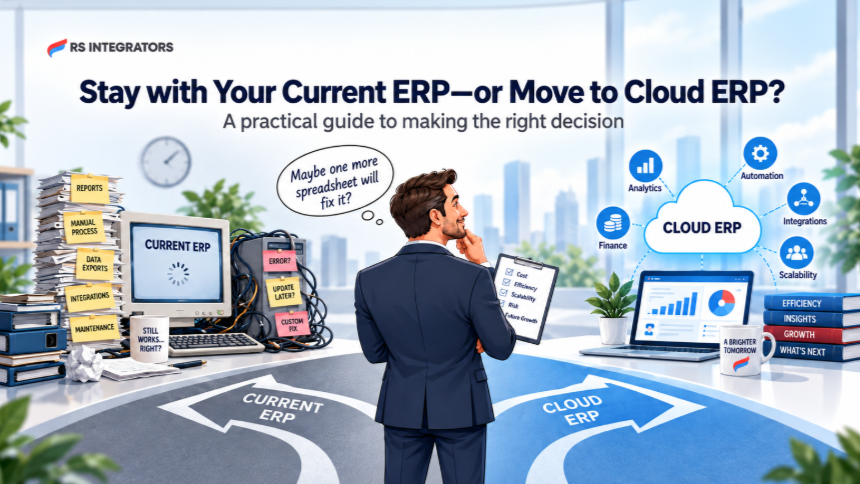
An ERP system rarely stops working overnight.
It usually continues processing transactions, generating reports and supporting daily operations. However, as the organization grows, teams may gradually begin working around the system rather than working within it.
Spreadsheets become essential. Reports require manual consolidation. New applications are connected through increasingly complex integrations. Business decisions take longer because reliable information is not available when it is needed.
At this stage, leadership faces a difficult question:
Should we continue with our current ERP, improve it or move to a modern cloud ERP?
The answer should not be based only on the age of the system or pressure to adopt new technology. It should be based on business value, operational complexity, scalability and the organization’s readiness for change.
The following seven questions can help businesses begin that evaluation.
1. Can the current ERP support the next stage of growth?
A system that supports today’s transaction volume may not necessarily support tomorrow’s business model.
Growth can introduce:
- New companies or business units
- Additional locations and countries
- New products and services
- Subscription or consumption-based billing
- Global taxation and compliance requirements
- Acquisitions and system consolidation
- Higher transaction volumes
- More complex financial reporting
If every stage of growth requires another workaround, spreadsheet or disconnected application, the ERP may no longer provide a scalable foundation.
The important question is not simply whether the current system works today. It is whether it can support where the organization plans to be during the next three to five years.
2. How much work happens outside the ERP?
Spreadsheets are useful business tools. But when they become necessary to complete core processes, they may indicate a larger system problem.
Common examples include:
- Finance teams manually consolidating reports
- Procurement approvals managed through email
- Sales teams maintaining separate customer data
- Inventory planning performed outside the ERP
- Accounts receivable teams tracking disputes manually
- Treasury teams combining bank balances in spreadsheets
- Employees repeatedly entering the same information into multiple systems
These activities create hidden operational costs. They also increase the risk of errors, duplicate information and inconsistent decisions.
A modern cloud ERP should not simply record completed transactions. It should connect processes, responsibilities and information across the organization.
3. Can leaders access reliable information when they need it?
Business leaders should not have to wait several days for teams to collect, reconcile and validate information before making an important decision.
Limited real-time visibility can affect:
- Cash-flow forecasting
- Customer collections
- Supplier payments
- Inventory availability
- Revenue reporting
- Project profitability
- Working-capital management
- Financial closing
When different departments work with different versions of the same data, discussions can become focused on validating numbers instead of taking action.
Cloud ERP platforms such as SAP S/4HANA Cloud can provide a more connected data foundation. Embedded analytics can help users examine business information within the process instead of transferring data between multiple tools before it becomes useful.
4. Are integrations enabling the business—or increasing complexity?
Most organizations operate with several applications. Integration itself is not a problem.
The challenge begins when integrations become difficult to understand, expensive to maintain or dependent on a small number of people.
Consider whether:
- Interfaces frequently fail
- The same information exists in several systems
- Changes in one application require multiple updates elsewhere
- New solutions take too long to connect
- Integration errors affect invoicing, reporting or fulfilment
- The organization lacks clear ownership of interfaces
For a relatively straightforward business model, the existing ERP and its integrations may still be sufficient.
However, a fast-growing technology or services company may need to manage subscription billing, usage information, global taxation, revenue recognition, acquisitions and real-time analytics. In this environment, integration complexity can quickly become a barrier to scale.
An ERP modernization decision should therefore consider the complete application landscape—not only the core ERP software.
5. What is the real cost of keeping the current system?
The annual maintenance fee does not represent the complete cost of a legacy ERP environment.
The total cost may also include:
- Infrastructure and hosting
- Custom development
- Integration maintenance
- Manual reconciliation
- External support
- Security updates
- System downtime
- Duplicate applications
- Employee time spent on workarounds
- Delayed business decisions
These costs are often distributed across departments, which makes them difficult to identify.
At the same time, cloud ERP also requires investment. Data migration, process redesign, integration, testing, training and change management must all be considered.
A fair business case should compare the total cost and risk of both options—not assume that either maintaining the current system or moving to the cloud will automatically be less expensive.
6. Is the organization willing to standardize its processes?
Moving to cloud ERP should not mean transferring every existing customization into a new platform.
Many customizations were created years ago to solve limitations that may no longer exist. Others may support processes that are no longer strategically important.
A fit-to-standard approach begins by examining proven business processes and identifying where the organization genuinely requires differentiation.
This requires teams to ask:
- Which requirements are legally necessary?
- Which processes create competitive value?
- Which variations exist only because of historical decisions?
- Which activities can be standardized?
- Which customizations can be replaced by configuration or built-in capabilities?
Standardization can support faster implementations, easier upgrades and lower long-term complexity.
However, it requires business participation. A cloud ERP project cannot succeed as an IT-only system replacement.
7. Is the organization ready for operational change?
Technology is only one part of ERP transformation.
The organization must also be ready to:
- Assign accountable business owners
- Make timely decisions
- Clean and validate data
- Redesign responsibilities
- Train users
- Manage process changes
- Measure business outcomes after implementation
Even the strongest cloud solution may struggle to deliver value when ownership is unclear or decisions are repeatedly delayed.
Before beginning an ERP transformation, leadership should agree on the problems being solved and the outcomes that will define success.
Those outcomes might include:
- Faster financial closing
- Better cash visibility
- Fewer manual approvals
- Improved inventory availability
- More accurate revenue reporting
- Easier business expansion
- Reduced system maintenance
- Stronger compliance and controls
Clear outcomes help keep the implementation focused on business value instead of technical activity.
When staying with the current ERP may be the right decision
Not every organization needs an immediate cloud ERP transformation.
Continuing with the current platform may be reasonable when:
- It supports the planned business strategy
- Reporting remains reliable and timely
- Integrations are stable and manageable
- Manual work is limited
- Security and support risks are controlled
- The cost of change is greater than the expected benefit
In some cases, improving selected processes, integrations or reporting capabilities may create sufficient value without replacing the complete ERP environment.
The decision should come from an honest assessment—not from the assumption that every older system must be replaced.
When cloud ERP deserves serious evaluation
A move to cloud ERP should be considered when the current environment is restricting growth, visibility or operational efficiency.
Warning signs may include:
- Increasing dependence on spreadsheets
- Slow or inconsistent reporting
- Complex legacy integrations
- Expensive custom development
- Difficulty supporting new entities or countries
- Limited automation
- Poor visibility across departments
- Growing compliance requirements
- An ERP version approaching the end of support
A modern platform such as SAP S/4HANA Cloud can support standardized processes, embedded analytics, built-in AI capabilities and workflow automation.
But technology alone does not create transformation. Value comes from combining the platform with clear process decisions, realistic scope, strong governance and organizational readiness.
The decision is not simply “stay or move”
For many organizations, the answer may not be an immediate full replacement.
A practical ERP strategy could involve:
- Stabilizing critical processes
- Identifying the largest operational gaps
- Simplifying unnecessary customizations
- Evaluating data and integration readiness
- Building a phased cloud ERP roadmap
This reduces decision fatigue by turning one large technology question into a structured business assessment.
The best ERP decision is not necessarily the newest system or the least expensive short-term option.
It is the option that gives the organization the right balance of scalability, visibility, control and business value.
At RS Integrators, we help growing organizations assess ERP modernization through the lens of business processes, integration complexity, operational readiness and future growth. Our approach focuses on practical transformation, fit-to-standard processes and SAP S/4HANA Cloud solutions aligned with measurable business outcomes.
Is your current ERP supporting the next stage of growth—or is your organization growing around its limitations?