
The Lowest-Priced Supplier May Be Your Most Expensive Supplier
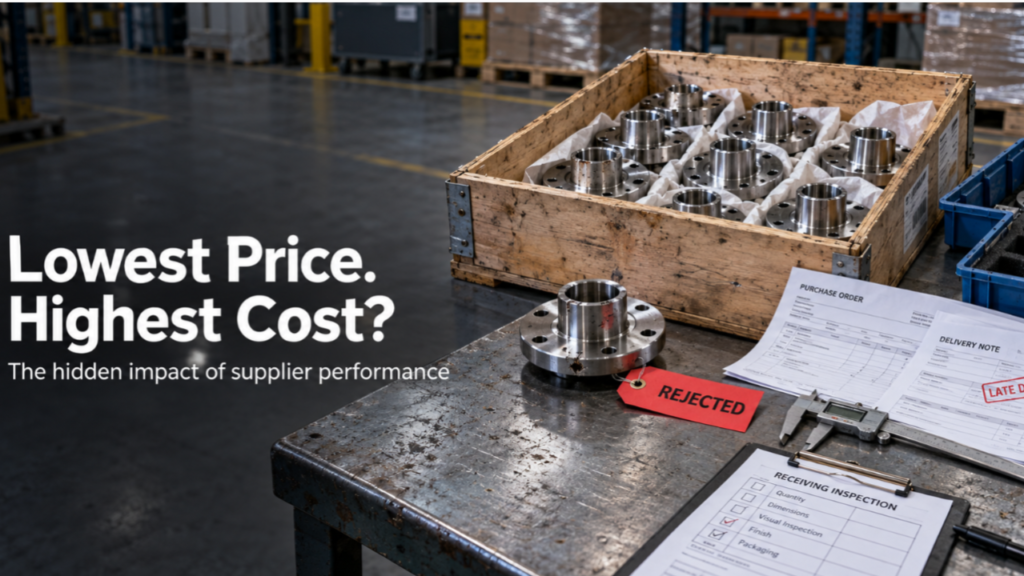
Manufacturers naturally pay close attention to purchase prices.
When two suppliers offer the same material, selecting the lower quotation may appear to be the most cost-effective decision.
But the purchase price is only one part of the actual cost.
A supplier offering a lower price may deliver late, supply incorrect quantities or provide materials that repeatedly fail quality inspection. These problems can interrupt production, create urgent purchasing requirements and delay customer deliveries.
The lowest-priced supplier may therefore become one of the most expensive suppliers to the business.
Supplier performance directly affects production
Procurement is not an isolated administrative function. It is directly connected to production planning, inventory, quality, sales and finance.
Consider a manufacturer that requires a specific bearing to complete an industrial motor.
The supplier’s price may be competitive, but what happens if the bearing:
- Arrives after the planned production date
- Arrives in a smaller quantity than ordered
- Does not meet the required quality standard
- Requires repeated follow-up from the purchasing team
- Has an unreliable or frequently changing lead time
Production may be rescheduled or stopped. Employees may wait for materials, and customer orders may be delayed.
The business may then need to purchase the component urgently from another supplier, accept additional freight costs or change the production schedule.
These costs may never appear in the original supplier quotation.
What is the true cost of an unreliable supplier?
The impact of poor supplier performance can include:
- Production downtime
- Emergency procurement
- Premium transportation charges
- Additional quality inspections
- Rework and material rejection
- Higher safety-stock requirements
- Delayed customer deliveries
- Overtime and rescheduling costs
- Additional purchasing follow-up
- Lost customer confidence
A material may have a lower unit price while creating a higher total cost for the manufacturer.
This is why supplier selection should not be based only on price.
Manufacturers should also consider delivery performance, quantity accuracy, material quality, responsiveness and supply risk.
Delivery reliability is more than being “on time”
A supplier may technically deliver within the agreed period but still create planning problems.
For example, a purchase order requires 10,000 components by a specific production date. The supplier delivers only 6,000 components without providing an early warning.
The delivery is not simply incomplete. It changes production capacity, inventory availability and customer commitments.
Manufacturers therefore need to compare:
- Requested delivery date
- Confirmed delivery date
- Actual delivery date
- Ordered quantity
- Confirmed quantity
- Received quantity
- Accepted quantity after quality inspection
These differences help the business understand whether the supplier is consistently supporting production requirements.
Supplier confirmations improve planning visibility
Creating a purchase order does not guarantee that the material will arrive as requested.
The supplier must confirm whether the required quantity and delivery date can be achieved.
If the supplier confirms a later date or reduced quantity, planners and buyers need this information early enough to respond.
They may need to:
- Reschedule production
- Identify an alternative supplier
- Expedite another purchase order
- Adjust customer delivery commitments
- Use available substitute materials
- Prioritize important production orders
Without reliable supplier confirmation, the planning system may assume that materials will arrive on time even when the supplier cannot meet the requirement.
The issue then becomes visible only when production is about to begin.
Quality is part of supplier performance
A delivery should not be considered successful merely because it arrived on time.
If the material fails inspection or creates defects during production, it was not truly available for use.
Supplier quality problems can cause:
- Material rejection
- Rework
- Production delays
- Additional inspection effort
- Customer complaints
- Warranty exposure
- Scrap and replacement costs
This is particularly important for manufacturers that depend on precise specifications, regulated materials or safety-critical components.
Supplier evaluation should therefore connect purchasing information with goods receipt and quality outcomes.
Price, delivery and quality must be viewed together
A supplier should not be evaluated through one measure alone.
A more complete evaluation can include:
Price performance
How does the actual purchase price compare with the agreed or expected price?
Delivery performance
Does the supplier deliver on the required date?
Quantity performance
Does the supplier provide the complete confirmed quantity?
Quality performance
How much of the delivered material is accepted, rejected or involved in quality complaints?
Responsiveness
How quickly does the supplier confirm orders and communicate possible delays?
Business risk
How dependent is production on this supplier, and are alternative sources available?
These measures allow procurement teams to distinguish between a supplier that is inexpensive and one that delivers dependable business value.
How SAP S/4HANA Cloud Public Edition can support procurement
SAP S/4HANA Cloud Public Edition supports connected sourcing and procurement processes, supplier confirmations, purchasing analytics and supplier evaluation.
Supplier performance can be analysed using factors such as delivery accuracy, price and quality.
Manufacturers can also monitor purchase-order items and review order acknowledgements to confirm whether suppliers can provide the requested materials in the required quantities and timeframes.
This can help procurement and manufacturing teams:
- Monitor open purchase orders
- Identify delivery risks earlier
- Compare ordered, confirmed and received quantities
- Evaluate supplier delivery performance
- Review price differences
- Consider supplier quality results
- Improve purchasing decisions
- Reduce dependence on offline follow-up spreadsheets
The technology provides information, but the organization must define how that information will be used.
For example, what performance level is acceptable? When should a supplier receive corrective action? When should procurement activate an alternative source?
Move from supplier reporting to supplier improvement
Supplier evaluation should not become a report that is reviewed only once a year.
It should support regular conversations and practical decisions.
If a supplier’s delivery performance is declining, the business should investigate the cause before production is affected.
If quality complaints repeatedly involve the same material, procurement, quality and engineering teams should work together to resolve the underlying issue.
If an important component depends on a single unreliable supplier, the company should assess whether an alternative source is required.
The purpose of supplier-performance information is not simply to rank suppliers.
It is to improve supply reliability.
Procurement decisions are manufacturing decisions
For manufacturers, supplier selection affects more than purchasing savings.
It influences:
- Production continuity
- Inventory levels
- Product quality
- Customer delivery performance
- Working capital
- Product cost
- Profitability
A lower purchase price provides limited value if the material does not arrive when production needs it.
At RS Integrators, we help industrial manufacturers connect procurement with production planning, inventory, quality and finance through SAP S/4HANA Cloud Public Edition.
Our focus is on building standardized and connected processes that provide earlier visibility into supply risks and support better operational decisions.
Before selecting the lowest quotation, manufacturers should ask:
Which supplier offers the lowest price—and which supplier delivers the lowest total cost?