
Why PO and Non-PO Invoices Need Different Workflows
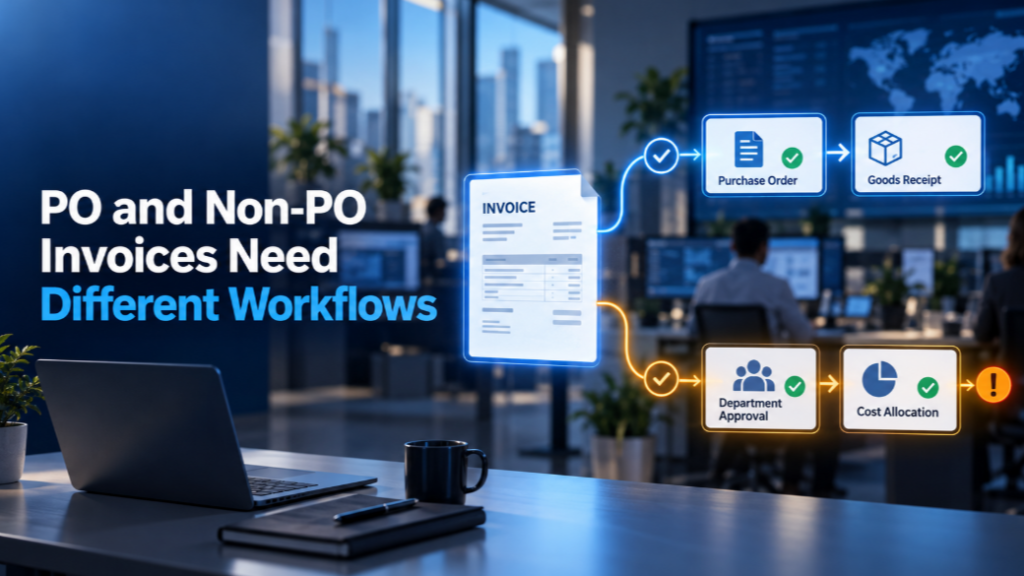
Many accounts payable problems begin with a simple assumption: every supplier invoice can follow the same process.
In reality, a PO invoice and a non-PO invoice require different checks, approvals and controls. When both are pushed through one generic workflow, the result is often delayed payments, repeated follow-ups and limited visibility into exceptions.
A PO invoice already has a purchasing trail
A PO-based invoice is connected to an approved purchase order. Depending on the transaction, it may also be supported by a goods receipt or service confirmation.
This gives the finance team information that can be used to validate the invoice:
- Was the purchase approved?
- Does the supplier match the purchase order?
- Do the quantity and price agree?
- Were the goods received or services confirmed?
- Is the invoice within the permitted tolerance?
A two-way match compares the invoice with the purchase order. A three-way match also includes the goods receipt.
When everything matches, the invoice may move forward with minimal manual involvement. When there is a mismatch, the workflow should direct the exception to the appropriate person.
For example, a quantity difference may need input from the receiving team, while a price difference may need to be reviewed by procurement.
The objective is not to ask an AP employee to investigate every invoice. It is to allow standard transactions to move efficiently while giving attention to genuine exceptions.
Non-PO invoices need a different control path
Not every business expense begins with a purchase order.
Rent, utilities, professional services, legal fees and certain recurring expenses may arrive as non-PO invoices. Since there is no purchase order available for matching, the system needs another way to confirm that the expense is valid.
A non-PO workflow may need to determine:
- Who requested or received the service?
- Which department should approve the expense?
- Which general ledger account should be used?
- Which cost centre, project or business unit should be charged?
- Does the amount require additional approval?
- Is the invoice potentially a duplicate?
If these decisions are managed through email, spreadsheets or informal follow-ups, an invoice can remain pending simply because nobody knows who owns the next action.
A structured workflow can route the invoice according to company, department, amount and expense category while maintaining a clear approval history.
The real problem is often exception ownership
Invoice automation is sometimes viewed mainly as document scanning and data extraction. Capturing invoice information is important, but it is only the beginning.
The larger operational question is:
What happens when an invoice cannot be processed automatically?
An effective AP process should identify the reason for the exception, assign it to the right person and make its status visible.
Without clear exception ownership, businesses may experience:
- Longer invoice-processing times
- Late-payment penalties
- Missed early-payment discounts
- Duplicate-payment risk
- Supplier enquiries and strained relationships
- Limited visibility into outstanding liabilities
- A growing backlog at period-end
This is why AP transformation must address the complete process—from invoice receipt and validation to matching, approval, posting and payment readiness.
Standardization should come before automation
Automating an inconsistent process does not remove the inconsistency. It can simply make a confusing process move faster.
Before selecting or configuring a solution, businesses should review questions such as:
- Which invoices must reference a purchase order?
- When is two-way or three-way matching required?
- What tolerances are acceptable?
- Who is responsible for each type of mismatch?
- Which non-PO expenses require additional approval?
- How should duplicate invoices be identified?
- What information must be available before posting?
Clear answers help create a more standardized process and reduce unnecessary workflow variations.
This fit-to-standard mindset also supports faster implementations because the project begins with proven processes and focuses attention on genuine business requirements.
Moving towards exception-driven accounts payable
The goal of AP automation should not be to remove people from every decision. It should reduce repetitive work and help people focus on the decisions that require judgement.
When invoice information, purchasing data, receipts and approvals are connected, built-in AI workflows and automation can support earlier exception identification and more effective routing.
The AP team can then spend less time chasing routine approvals and more time managing risk, analysing exceptions and supporting suppliers.
A better question for AP transformation
Instead of asking:
“How can we process invoices faster?”
Businesses should ask:
“How can the right invoices move automatically while the right people handle exceptions?”
That shift creates a stronger foundation for control, visibility and scalable growth.
RS Integrators helps organizations assess their current finance processes and plan practical SAP S/4HANA Cloud transformations. Our approach focuses on process standardization, faster implementations and solutions aligned with the organization’s operational requirements.
If PO and non-PO invoices are following the same approval path in your organization, it may be time to review where the delays and exceptions are really occurring.