
Your MRP Problem May Actually Be a Working-Capital and Revenue Problem
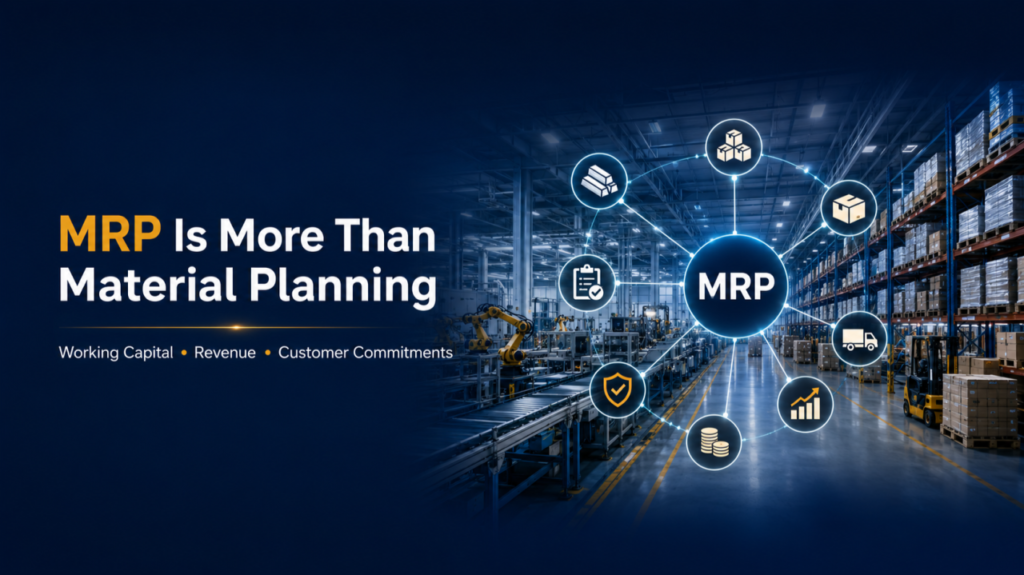
Manufacturers often view material planning through one lens:
“Do we have enough material to keep production running?”
That question is necessary—but it is no longer sufficient.
A material shortage can trigger a chain reaction:
Material shortage → Production disruption → Quality delays → Missed customer commitment → Revenue impact
At the other extreme:
Excess inventory → Working capital tied up → Higher carrying costs → Expiry / obsolescence risk
This is why the evolution of MRP in SAP S/4HANA deserves attention beyond the supply-chain organization.
The strategic opportunity is to move from reactive material planning to connected, exception-driven decision making.
When procurement, inventory, production, and quality information are connected within the ERP landscape, planners can identify potential constraints earlier—before they become production or customer-service issues.
And with AI-enabled workflows increasingly embedded into enterprise processes, the role of the planner can evolve from monitoring transactions to managing exceptions and making decisions.
But technology alone will not solve the problem.
- One of the biggest lessons we see in ERP transformation is that process complexity often becomes a bigger constraint than system capability.
- Manufacturers that use transformation as an opportunity to standardize planning processes, simplify decision points, and establish common data models can create a much more scalable operating foundation.
That matters especially for growing manufacturers.
The objective should not be:
“Implement MRP successfully.”
It should be:
“Build a planning operating model that protects customer commitments while optimizing working capital.”
That is a very different transformation agenda.
The future of MRP is not about planning more materials. It is about making better decisions earlier—and connecting those decisions directly to business outcomes.